No recent searches!

    Escape Himalaya
    • Certificate ofExcellence 2025
    • Whatsapp, Viber+977 9851006121
      • Everest Region
        • Everest Base Camp Trek - 14 Days
        • Everest Base Camp - Chola Pass - Gokyo Trek - 17 Days
        • Everest Base Camp Short Trek - 13 Days
        • Everest Base Camp Luxury Trek - 15 Days
        • Everest Base Camp Heli Shuttle Trek - 12 Days
        • Luxury Everest View Trek - 9 Days
        • Everest Panorama Trek - 9 Days
        • Everest Three High Passes Trek - 20 Days
        • Everest Base Camp Trek Heli Return to Kathmandu-11 Days - 11 Days
        • Everest Base Camp Trek for Seniors - 20 Days
        • Everest View Trek - 7 Days
      • Annapurna Region
        • Annapurna Base Camp Trek - 14 Days
        • Annapurna Circuit Trek - 14 Days
        • Mardi Himal Trek - 8 Days
        • Jomsom Muktinath Trek with Poon Hill - 9 Days
        • Short Annapurna Base Camp Trek - 6 Days Hike - 9 Days
        • Annapurna Circuit Tilicho Lake Trek - 17 Days
        • Annapurna Family Trek - 8 Days
        • Annapurna Base Camp Trek Heli Return to Pokhara - 10 Days
        • Annapurna Hot Spring Trek - 8 Days
        • Annapurna Trek with Chitwan Tour - 9 Days
        • Shortest Annapurna Base Camp Trek - 9 Days
      • Langtang Region
        • Langtang Valley Trek - 10 Days
        • Bhairav Kunda Trek - 14 Days
        • Helambu Trek - 8 Days
        • Langtang Helicopter Tour - 3 hrs
        • Langtang Gosainkunda Helambu Trek - 16 Days
        • Tamang Heritage Trail - 10 Days
        • Langtang Gosainkunda Trek - 13 days
      • Manaslu Region
        • Manaslu Circuit Trek - 14 Days
        • Manaslu Tsum Valley Trek Itinerary - 20 Days - 20 Days
        • Tsum Valley Trek - 13 days
      • Mustang Region
        • Upper Mustang Trek - 16 Days
        • Mustang Tiji Festival Trek - 18 Days
        • Lower Mustang Trek - 14 Days
        • Jomsom Muktinath Trek with Poon Hill - 9 Days
        • Upper Mustang Jeep Tour - 11 days
      • Dolpo Region
        • Upper Dolpo Trek - 25 Days
        • Lower Dolpo Trek - 18 Days
      • Summer Treks
        • Lower Dolpo Trek - 18 Days
        • Upper Mustang Trek - 16 Days
        • Lower Mustang Trek - 14 Days
        • Rara Lake Trek - 16 Days
        • Upper Dolpo Trek - 25 Days
        • Upper Mustang Jeep Tour - 11 days
      • Winter Treks Package
        • Short Annapurna Base Camp Trek - 6 Days Hike - 9 Days
        • Mardi Himal Trek - 8 Days
        • Australian Camp Short Trek in Pokhara - 5 Days
        • Annapurna Family Trek - 8 Days
        • Nepal Adventure Tour - 12 Days
        • Everest View Trek - 7 Days
        • Helambu Trek - 8 Days
      • Less Touristic Trails
        • Rara Lake Trek - 16 Days
        • Upper Dolpo Trek - 25 Days
        • Makalu Base Camp Trek - 21 days
        • Langtang Gosainkunda Helambu Trek - 16 Days
        • Pikey Peak Trek - 12 Days
        • Lower Dolpo Trek - 18 Days
        • Bhairav Kunda Trek - 14 Days
        • Kanchenjunga Trek - 22 days
        • Helambu Trek - 8 Days
      • Bhaktapur Patan Tour - 6 Hours
      • Kathmandu Day Tour - 6 Hours
      • Chitwan Jungle Safari Tour - 3 Days
      • Kathmandu Nagarkot Sightseeing Tour - 4 Days
      • Langtang Helicopter Tour - 3 hrs
      • Explore Nepal Tour - 10 Days
      • Bardia National Park Tour - 4 Days
      • Nepal Adventure Tour - 12 Days
      • Nepal Discover Tours - 6 Days
      • Everest Helicopter Tour - 3 Hours
      • Tour of Kathmandu's 7 UNESCO World Heritage Sites  - 1 days
      • Pisang Peak Climbing - 19 days
      • Lobuche Peak Climbing - 18 Days
      • Island Peak Climbing - 20 days
      • Tharpu Chuli Peak Climbing - 0 days
      • Naya Kanga Peak Climbing - 15 days
      • Mera Peak Climbing - 19 Days
      • Mera and Island Peak Climbing via Amphu Laptsa Pass - 23 days
      • Nepal Tibet Bhutan Tours - 13 days
      • Bhutan Experience Tour - 10 days
      • Nepal Bhutan Darjeeling Tour - 14 days
      • Glimpse Tours Bhutan - 8 days
      • Chomolhari Trek - 0 days
      • Laya Gasa Trek - 0 days
      • Druk Path Trek - 0 days
      • Simikot Kailash Lhasa Tour - 0 days
      • Nepal Tibet Bhutan Tours - 13 days
      • Tibet Everest Base Camp Tour - 11 days
      • Lhasa to Kathmandu Tours - 10 days
      • Everest Advanced BC Trek - 20 days
      • Lhasa Sightseeing Tours - 7 days
      • Saga Dawa Festival Tours - 14 days
      • Our Team
      • How to Book a Trip
      • Why Escape Himalaya
      • Terms and Conditions
      • Legal Documents
      • Nepal Tourist Visa Information
      • Travel Insurance
      • Equipment Checklist
      • Privacy Policy
    • Travel Guide
    • Contact Us
    Bookings are currently open for Himalayas during the 2025/26 season. Book Now
    • Home
    • Enquire us
    • Whatsapp
    • Search
    Escape Himalaya+977 9851006121Whatsapp, Viber
    Hotel Wood Apple

    Escape Himalaya - Adventure Tours and Trekking in Nepal more...

    Contact Us

    • +977-1 4980242
    • [email protected]
    • Khusibu, Kathmandu, Nepal
    Make an EnquiryCall Us
    Nepal Goverment
    Nepal Tourism Board
    TAAN
    NMA
    Trip Advisor
    Tour Radar
    Tour Radar

    Things to do in Nepal

    • Peak Climbing
    • Summer Treks
    • Winter Treks Package
    • Family Vacation
    • Wildlife Adventure
    • Helicopter Tours

    Company Profile

    • Our Team
    • How to Book a Trip
    • Why Escape Himalaya
    • Terms and Conditions
    • Legal Documents
    • Nepal Tourist Visa Information
    • Travel Insurance
    • Equipment Checklist
    • Privacy Policy

    Subscribe Newsletter

    To receive travel updates via email

    • 24/7 Whatsapp Contact
      +977-9851006121 (Raj),+977-9851363580 (Suman)
    • Send us mail
      [email protected], [email protected]
    • Services and Support
      Khusibu, Kathmandu, Nepal P.O. Box: 5596
    • Follow us on
    © 2015 - 2025 Escape Himalaya. All Rights Reserved.
    Card
    1. Home
    2. Nepal
    3. Trekking in Nepal
    4. Everest Region
    5. Everest Base Camp Short Trek

    Everest Base Camp Short Trek

    5/5 from 7 reviews
    Everest View Trekking In Nepal
    Short Everest Base Camp trek
    Everest View Hotel Trek
    Everest Panorama Trek
    Searching for the supreme trekking adventure? The trip to Everest Base Camp provides a unique mixture of stunning views, thrilling suspension bridge crossings, and different Sherpa cultures. Imagine yourself surrounded by heart-stopping Himalayan peaks, challenging but rewarding trails, and the base camp of the World's tallest mountain-Mount Everest (8848 m).

    Trip Fact

    • DestinationNepal
    • Durations13 Days
    • Trip DifficultyModerate
    • ActivitiesTrekking
    • AccommodationHotels / Teahouses
    • MealsBreakfast, Lunch, Dinner
    • Mx.altitude5545m.
    • VehicleCar / Flight
    • Group SizeMin. 1 Pax

    Overview

    Short Everest Base Camp Trek is made for those who want to reach Everest Base Camp quickly. Many people come to Solu-Khumbu every year to fulfill their dream of hiking to the Base Camp of Mount Everest, the world's tallest mountain.

    Our 13-day Short Everest Base Camp Trek is a unique adventure tailored for mountain lovers. It strikes the perfect balance between challenge and comfort with our experienced guides by your side. We've meticulously planned every detail, ensuring you can immerse yourself in the breathtaking beauty of the Everest foothills without any worries.

    On the way to Everest Base Camp, you'll see some famous places like Lukla (the starting point), Namche Bazaar (a renowned market town), Tengboche (a village with a monastery), Gorakshep (the last stop before Base Camp), and Kala Patthar (the best spot for a clear view of Mt. Everest). Kala Patthar is the highest point on your short trek to Everest Base Camp.

    Everest Base Camp Short Trek Highlights

    • You will trek to the foot of the world's tallest peak, which stands at 8848.86 meters.
    • Experience an exciting and thrilling flight to Lukla, the gateway to Everest.
    • Discover the crowded Namche Bazaar, a Sherpa trading center.
    • Visit the peaceful beauty of Tengboche Monastery.
    • Trek among dramatic glaciers to Dingboche.
    • Marvel at Imja River Valley Views from Nangkartshang Peak.
    • Reach Lobuche and witness the Khumbu Glacier.
    • Conquer to Everest Base Camp and stand in awe at the foot of Mount Everest.
    • Watch the sunrise from Kala Patthar, with breathtaking views of Everest.
    • Learn about ethnic Sherpa people, their unique culture, and lifestyle.
    • Traverse-rich Sagarmatha National Park.
    • Enticing views of mighty Everest, Lhotse, Nuptse, Ama-Dablam, Cho-Oyu, Kongde Ri, Thamserku & more.

    History of the Everest

    The history of Everest Base Camp (EBC) is a fascinating tale intertwined with the evolution of mountaineering, particularly the relentless pursuit to conquer Mount Everest, the pinnacle of human achievement in the climbing world.

    Early Ascents (1920-1950s)

    In the early days, trekkers and explorers focused on climbing Mt. Everest. They tried different methods from Nepal and Tibet to climb up. George Mallory's safari in the 1920s made progress on the north face route, reaching 7,000 meters. Sadly, in 1922, seven Sherpa porters died in an avalanche on Everest, showing how dangerous it is. These early treks also set up primary trails and camps for future trekkers.

    After many tries, Sir Edmund Hillary and Tenzing Sherpa made the first successful climb of Mt. Everest on May 29, 1953. The Khumbu region around Mt. Everest became a national park in 1976. It's called Sagarmatha National Park and has been a UNESCO World Heritage Site since 1979.

    Development of Trekking (1960s onwards)

    From the 1960s onwards, climbing remained a specialized activity, and trekking in the Everest region became increasingly crowd-pleasing. We've taken every measure to ensure your safety and comfort, with tea houses set up along the trekking route, providing basic accommodation and food for trekkers. As infrastructure and safety measures improved, more people were attracted to the beauty of the Himalayas. Everest Base Camp transitioned from purely serving mountaineers to becoming a beloved destination for trekkers.

    Present-day EBC

    Today, Everest Base Camp (EBC) is a starting point for climbers aiming to conquer Mount Everest, but it's primarily popular among adventure trekkers. The local economy depends highly on tourism, with lodges, restaurants, and guide services benefiting from the steady stream of trekkers. There's a growing emphasis on environmental conservation and sustainability, with efforts to manage waste and promote responsible tourism.

    Newest Attraction - Bungee Jump on Everest Base Camp Trail!

    Everest Base Camp Trek Just Got Even More Epic - Introducing Bungee Jumping Off the Hillary Bridge! The Everest Base Camp trek is renowned for its stunning views, challenging climbs, and the bragging rights it bestows. But what if you're craving an extra dose of heart-pounding action? Brace yourself for a brand-new adventure- a bungee jump from the legendary Hillary Bridge (Suspension Bridge) on your way to Everest Base Camp! You read that right; now, you can take a leap of faith from this iconic bridge before reaching Namche Bazaar.

    Hillary Bridge Bungee Jump in Nepal costs approximately NPR 7,500 - 8,000 (around USD 60 - 65) per person. This fee includes the bungee jump itself, safety equipment,

    This famous bridge, named after Sir Edmund Hillary, towers—about 135 meters (443.192ft) above the rushing Dudh Koshi River, which cuts through the Himalayas. For years, the Hillary Bridge has been a symbol of adventure for trekkers. But now, it has become something more incredible. A successful test jump was recently conducted, and the brave souls have already leaped. So, are you ready to turn your dreams of bungee jumping and trekking into reality? Don't miss this golden opportunity to write a new chapter in your history of adventure! Book your trip to the EBC trek with us and prepare for the fun of your entire life!

    Is this a Right Trip for me?

    A 13-day trek package to Everest base camp is the best itinerary for hikers even with less experience in similar elevations. This EBC Trek course deliberately tries to present the most gratifying attractions in the Khumbu region. Traveling with Escape Himalaya, you can unlock Khumbu's concealment and build a genuine interaction with the Himalayas. Besides this short trek, we operate major trekking courses all over Nepal.

    Physical Fitness for Short Everest Trek

    The journey to Everest Base Camp will be much more enjoyable, and the chances of completing the trek will be greater if one is in good physical shape. This trek basiscally includes 5-7 hours of hiking per day on rough, sometimes steep, terrain, often at a high altitude with low oxygen levels. One needs to get into routine cardio activities such as running, cycling, or swimming to be prepared. This should be combined with strength training, but more importantly, leg workouts. We also suggest including hill climbing or stair climbing in your workout regime to give you a feel for the trekking conditions. If you are really well-prepared, you will stay confident throughout, and that really makes this magnificent journey very special.

    Most important thing to consider: Travel Insurance

    Congratulations on one of the most thrilling treks into the mountains of majesty! As you get ready for this most unforgettable journey, here comes the most important thing to consider: travel insurance. Independent trekking in mountain and rugged areas is not devoid of risks, which could mean injuries, falling suddenly ill, or even an emergency evacuation. Medical care can be very expensive, not to mention hard to access in such areas. These can add up quickly if you have an accident or experience some other mishap and don't have insurance. Having comprehensive travel insurance means you will know you're protected against the unpredictable, so you can have peace of mind as you enjoy the trekking experience.

    Alternative Option

    The 20-day Everest Base Camp Trek for Seniors is a specially crafted travel package tailored to the needs of older adults and children. It offers a beautiful opportunity for families to explore the stunning landscapes of Nepal together. With a focus on comfort and ease, this trek ensures a smooth and enjoyable journey for all participants, taking into account their specific needs and preferences.

    The Everest Base Camp Heli Shuttle Trek is a 12-day adventure that combines hiking and an exciting helicopter ride. Experience the thrill of reaching the world's tallest mountain base camp and enjoy a scenic helicopter ride back to Lukla, skipping the return walk.

    Experience the 16-day Short Classic Trek to EBC, a popular alternative route starting with a drive to Phaplu. Many travelers opt for this unique journey instead of flying to Lukla.

    This 17-day Everest Cho La Pass Trek goes beyond the classic Everest Base Camp experience. It pushes adventurers through challenging Himalayan terrain, including the thrilling Cho La Pass (5,420 meters).

    The legendary 14-day Everest Base Camp trek is a phenomenal journey that takes you to the very lap of Mount Everest. Witness stunning natural beauty, rich cultural experiences, and the awe-inspiring landscapes of eastern Nepal. Hiking through the Khumbu region on this 14-day adventure offers a genuinely all-encompassing experience that is a must-do for any avid traveler.

    Come along on Escape Himalaya Trek's 16-day Everest Base Camp Luxury Trek. Enjoy comfortable stays and excellent service while exploring Sherpa culture. Be sure to see the world's highest peak up close, surrounded by stunning views, all in luxury comfort.

    By letting us know what you're interested in, you can customize the trip according to your preferences.
    Weight Limite For Lukla Flight

    The weight limit for flights from Kathmandu to Lukla is typically 15 kilograms (33 pounds) per person for checked luggage. This limit is strictly enforced by the airlines due to the small size of the aircraft and the limited cargo capacity. Passengers are allowed to carry additional weight in the form of hand luggage, but this is usually restricted to 5 kilograms (11 pounds). If you exceed the weight limit, you may be required to pay additional fees or arrange for the excess baggage to be sent by another means, such as via a porter or a cargo flight.

    Preparing for the flight to Lukla requires careful attention to weight limits, Airlines said only 15kg for each person including hand carry bag as excess luggage can pay extra charges, making it essential to pack efficiently.

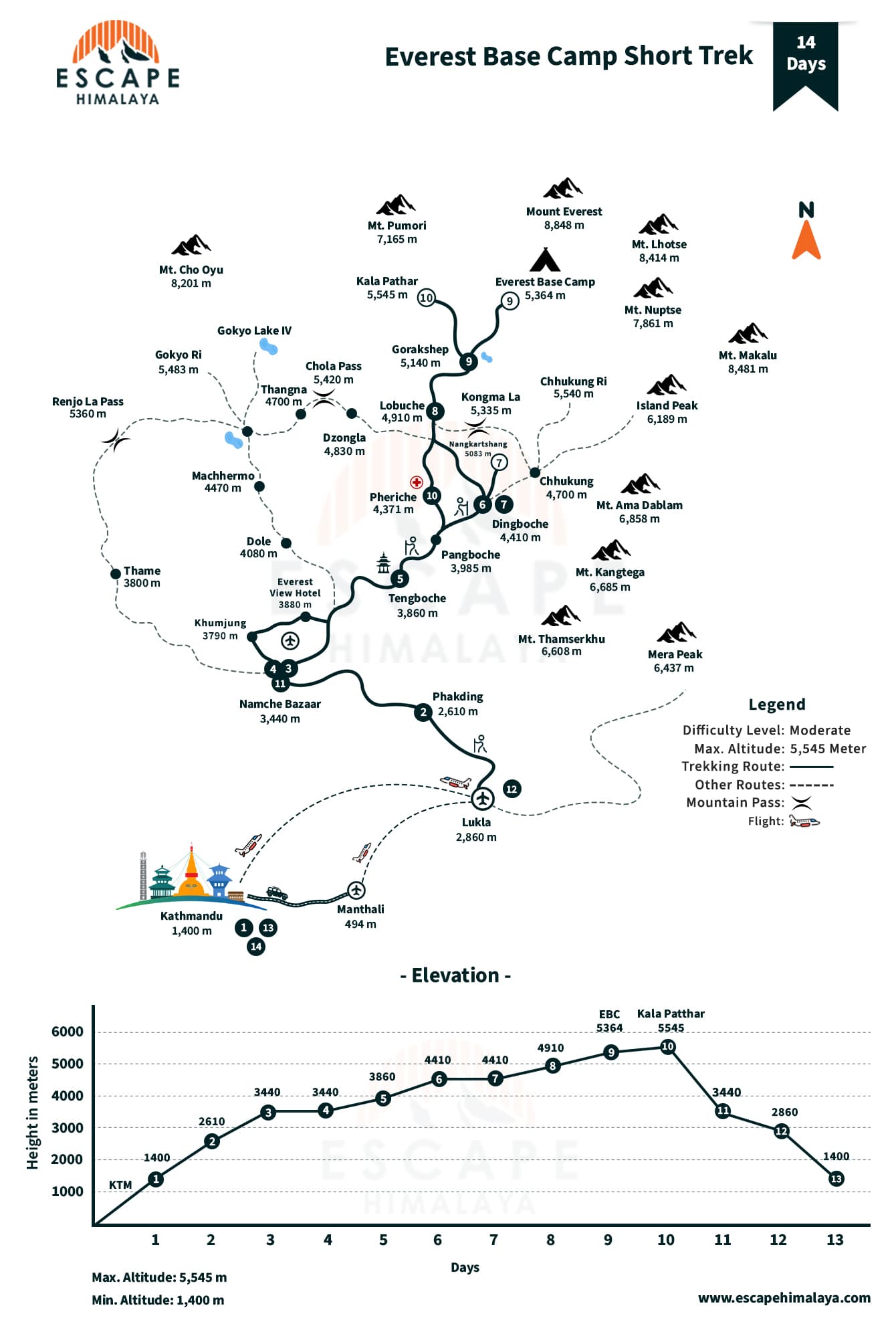
    Detail Itinerary

    Expand all +
    1Day 01

    Arrive At Tribhuwan International Airport, Kathmandu

    Upon arrival at the airport, a representative from Escape Himalaya will pick you up and transfer you to the hotel. At the hotel, we will talk about your trip. You can relax for the remaining daytime.

    1. Max. Elevation:1400m.
    2. Durations30 minutes
    3. Distance6 km
    4. AccommodationHotel
    2Day 02

    Fly To Lukla And Trek To Phakding (2,652m/8,699ft), Walking Distance - 8 km, Duration - 3 hours

    We shall take on a beautiful morning flight to Lukla this day. The flight presents you with some pretty sights of gradually changing landscapes. Then, we will begin our trek with an easy walk passing through the village of Chaurikharka and walking down towards Dudh Koshi Ghat. Trekking along the shore of Dudh Koshi River, we will reach Phakding for a stopover.

    1. Max. Elevation:2860m.
    2. Durations30 minutes flight
    3. Distance8 km
    4. MealsBreakfast, Lunch, and Dinner Included
    5. AccommodationGuesthouse
    3Day 03

    Phakding To Namche Bazaar (3,440m/11,283ft), Walking Distance - 12 km, Duration - 6 hours

    We will head off from Phakding on this day and pass through splendid rhododendron forests, the wood blossoming rich with magnolia and aligned with fir trees. The area will be full of blooming rhododendron flowers during springtime. We will also pass through Jorsalle (2,805m) and pass by the junction of Dudh Koshi and Bhote Koshi. We will climb for some time and get the first glimpse of Everest if the weather is clear and the clouds part way. Ascending further, we will reach Namche Bazaar, a flourishing Sherpa village and an administrative hub of the Khumbu region.

    1. Max. Elevation:3440m.
    2. Durations7 hours
    3. Distance10 km
    4. MealsBreakfast, Lunch, and Dinner Included
    5. AccommodationGuesthouse
    4Day 04

    Trek To Tengboche (3,860m/12,660ft), Walking Distance - 11 km, Duration - 5 hours

    We will move ahead from Namche Bazaar and continue walking all along the rushing glacial waters of the Dudh Koshi. On the way to Sanasa, we will pass by the ethereal rhododendron forests. You may also see faunas like the multi-colored pheasants, musk deer, and the Himalayan Thar. From Sanasa, we will walk vertically up to the famous Tengboche Monastery. It is the largest monastery in the Khumbu region which presents magnificent peak views of Mt. Everest, Mt. Lhotse, Mt. Nuptse, Mt. Ama Dablam, and The Thamserku.

    1. Max. Elevation:3860m.
    2. Durations5 hours
    3. Distance10-11 km
    4. MealsBreakfast, Lunch, and Dinner Included
    5. AccommodationGuesthouse
    5Day 05

    Tengboche To Dingboche (4,410m/14,464ft), Walking Distance - 12 km, Duration - 5 hours

    We will trek for around 5 hours to get to Dingboche on this day. Our trek begins with an adjacent route with the rhododendron forest from Tengboche to Debuche. We will also traverse the raging Imja River and pass by Pangboche village, the region's biggest village occupied by Sherpa people. Here we can walk to Pangboche Monastery, one of the ancient monasteries. We will have quite a challenging walk in the afternoon as the scenery turns dry and deserted before reaching Dingboche.

    1. Max. Elevation:4410m.
    2. Durations5 hours
    3. Distance11-12 km
    4. MealsBreakfast, Lunch, and Dinner Included
    5. AccommodationGuesthouse
    6Day 06

    Acclimatization Day at Dingboche - Hike to Nangkartshang Peak (5,083m/16,676ft) and back, Walking Distance - 6 km, Duration - 5 hours

    We will have acclimatization day in Dingboche on this day. We will also have a short hike to Nangkartsang Peak, often known as Nagerjun Hill. The hill is set just above Dingboche, generally climbed to get accustomed to the high altitude. We will have a pretty demanding day as the path is steeper. It takes around 5 hours to reach the top and get back to Dingboche, where the stunning views of Lobuche East (6,119m), Kangtega (6,685m), Taboche (6,367m), Lobuche West (6,145m), Thamserku (6,608m), and Ama Dablam (6,812m) will mesmerize us. Then, we will return to Dingboche.

    1. Max. Elevation:5083m.
    2. Durations2-3 hours
    3. Distance5-6 km
    4. MealsBreakfast, Lunch, and Dinner Included
    5. AccommodationGuesthouse
    7Day 07

    Trek To Lobuche (4,910m/16,105ft), Walking Distance - 12 km, Duration - 5 hours

    We will climb steeply up to Lobuche, leaving behind Dingboche, passing a chorten. We will also pass by Dugla, located at the tip of the Khumbu Glacier. With a vertical and small climb up, we will stroll to Chukpo Lari and see memorials put up in tribute to those who lost their lives in the Khumbu region. Also, you cannot ignore the stunning vista of the enormous mountains. We will finally reach Lobuche (4,910m) with a hassle-free walk.

    1. Max. Elevation:1910m.
    2. Durations5 hours
    3. Distance12 km
    4. MealsBreakfast, Lunch, and Dinner Included
    5. AccommodationGuesthouse
    8Day 08

    Trek to Gorak Shep (5,181m/16,994ft) - Hike to Everest Base Camp (5,364m/17,594ft) and back, Walking Distance - 15 km, Duration - 8 hours

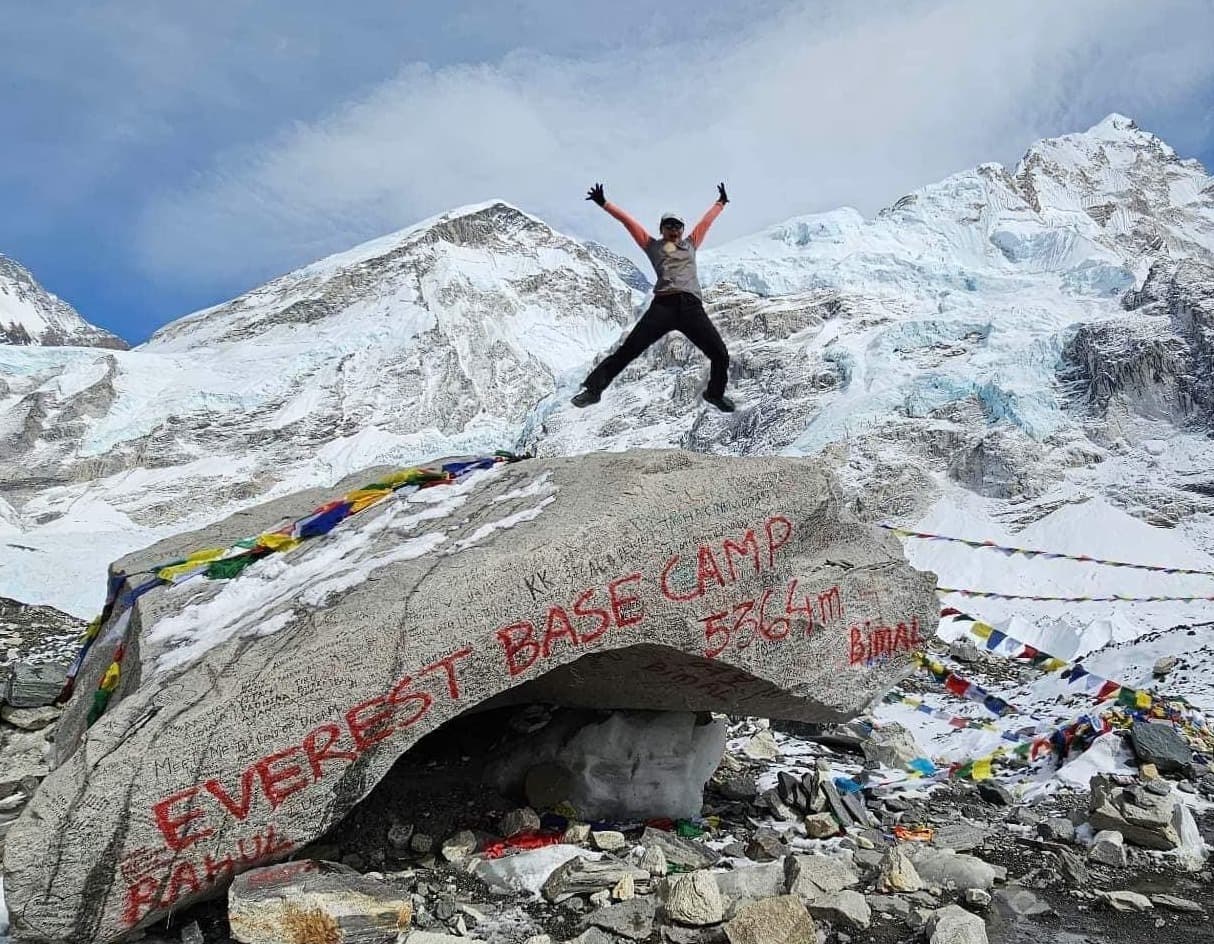
    Today is an integral part of the trek as it incorporates making it to the Everest Base Camp. Upon reaching the foot of Mt. Everest, the views of Everest, Mahalangur, Khumbutse, Lingtren, Mt. Pumori, and Mt. Nuptse will enthrall us.

    Departing from Lobuche, we will walk towards Gorak Shep from Lobuche on this day. We will also walk further up to the top, passing the gush of Changri Glacier to get the sight of Kala Patthar, which translates to "Black Rock" in Nepali. Walking further ahead, we will reach the Everest Base Camp, where we shall have a fantastic time drowning ourselves in the majesty of Sagarmatha! Then, we will return to Gorak Shep.

    1. Max. Elevation:5364m.
    2. Durations5-6 hours
    3. Distance14-15 km
    4. MealsBreakfast, Lunch, and Dinner Included
    5. AccommodationGuesthouse
    9Day 09

    Hike To Kala Patthar (5,545m/18,188ft) & Trek to Pheriche (4,210m/13,809ft), Walking Distance - 13 km, Duration - 7 hours

    We will walk from Gorak Shep to Kala Patthar early in the morning to witness the magnificent sunrise view over Mt. Everest. Additionally, the spectacular views of Changtse, Nuptse, Lhotse, and the others will be utterly alluring. At Kala Patthar, you will spend some rewarding time remaining in your memories forever. Then, we will walk down to Gorak Shep, have breakfast, and trek further to Pheriche.

    1. Max. Elevation:5645m.
    2. Durations3 hours
    3. Distance13-14 km
    4. MealsBreakfast, Lunch, and Dinner Included
    5. AccommodationGuesthouse
    10Day 10

    Trek To Namche (3,440m/11,283ft), Walking Distance - 15 km, Duration - 7 hours

    On this day, we will walk back to Namche Bazaar, which takes around 7 hours. We will pass several ups and downs of the terrain on the way and also pass by hillsides brimming with juniper and rhododendron trees. Traversing over Dudh Koshi River by a bridge, we will descend to an area where we may see wildlife like pheasants, mountains, goats, and many others. The path finally reaches Sanasa, where incredible views of the Ama Dablam, Nuptse, and Thamserku mountains will appear. We will reach Namche Bazaar through rugged, twisty paths and jungle.

    1. Max. Elevation:3440m.
    2. Durations7 hours
    3. Distance14-15 km
    4. MealsBreakfast, Lunch, and Dinner Included
    5. AccommodationGuesthouse
    11Day 11

    Trek To Lukla (2,800m/9,184ft), Walking Distance - 19 km, Duration - 7 hours

    We will walk downhill from Namche to travel along the Dudh Koshi River again. Then, we will stroll to Monjo, where we must accomplish the formalities at the Sagarmatha National Park check post. Subsequently, we will walk towards Phakding and continue walking to Lukla. You can relax and remember the fabulous memories of trekking.

    1. Max. Elevation:2860m.
    2. Durations7 hours
    3. Distance19 km
    4. MealsBreakfast, Lunch, and Dinner Included
    5. AccommodationGuesthouse
    12Day 12

    Flight From Lukla To Kathmandu

    We will return from Lukla to Kathmandu on a short and scenic flight. You will transfer to the hotel upon landing at Tribhuwan International Airport.

    1. Max. Elevation:1400m.
    2. Durations30 minutes flight
    3. MealsBreakfast Included
    4. AccommodationHotel
    13Day 13

    Farewell

    One of our company representatives will transfer you from the hotel to Tribhuwan International Airport three hours before your scheduled flight. And you will then depart with many unforgettable memories of the experience and beautiful things to share.

    1. Max. Elevation:1400m.
    2. Durations30 minutes
    3. Distance6 km
    4. MealsBreakfast Included

    If the provided schedule isn't suitable for you, we are able to create personalized travel arrangements according to your preferences and requirements.

    Customize My Trip

    Cost Details

    Cost Includes

    • All airport pick-up and drop by private vehicle
    • Two night's accommodation with breakfast at a 3-star category hotel in Kathmandu. https://www.hotelwoodapple.com/
    • Full board meals (Breakfast, Lunch, Dinner) with tea/coffee during the trek
    • Seasonal fruits - after dinner snacks during the trek
    • Best available twin sharing lodge to lodge accommodation during the trek (We provide attached bathrooms with hot showers at Lukla, Phakding, and Namche.)
    • One highly experienced, helpful, and certified trekking guide and porters to carry luggage (1 porter for two people), including their food, accommodation, salary, equipment, and accidental insurance
    • Round trip flight Kathmandu – Lukla and Lukla – Kathmandu, including departure taxes
    • Escape Himalaya Duffle Bag, Down Jacket, and Sleeping Bag during the trek
    • Escape Himalaya T-shirt, Trekking Map, and Trip Achievement Certificate
    • A comprehensive first-aid medical kit and water purification tablets
    • Sagarmatha National Park Permit and Khumbu Pasang Lhamu Rural Municipality Entrance Permit Fees
    • All government taxes & office service charges

    Cost Excludes

    • Accommodation and meals while in Kathmandu
    • Travel Insurance
    • International Airfare
    • Nepal Entry Visa (You can obtain a visa upon your arrival at Tribhuwan International Airport in Kathmandu. A multiple-entry tourist visa suitable for 30 days can be obtained by paying USD 50 or equivalent foreign currency. Similarly, multiple-entry tourist visas for 90 days can be obtained by paying USD 125. Please bring two copies of passport-size photos.)
    • Cold Drinks, including Coke, Water, Fanta, etc.
    • Snacks and other personal expenses
    • Hot showers during the trek except in Phakding, Namche, and Lukla
    • Personal Trekking Equipment
    • Wi-Fi / Internet during the trek
    • Tips and gratuities for trekking staff and drivers

    Dates & Availability

    • 14th Jan 2026From Kathmandu
      26th Jan 2026To Kathmandu
      guaranteed
      US $1150Per person
      Book Now
    • 15th Jan 2026From Kathmandu
      27th Jan 2026To Kathmandu
      guaranteed
      US $1150Per person
      Book Now
    • 23rd Jan 2026From Kathmandu
      4th Feb 2026To Kathmandu
      guaranteed
      US $1150Per person
      Book Now
    • 24th Jan 2026From Kathmandu
      5th Feb 2026To Kathmandu
      guaranteed
      US $1150Per person
      Book Now
    • 26th Jan 2026From Kathmandu
      7th Feb 2026To Kathmandu
      guaranteed
      US $1150Per person
      Book Now
    • 28th Jan 2026From Kathmandu
      9th Feb 2026To Kathmandu
      guaranteed
      US $1150Per person
      Book Now
    • 29th Jan 2026From Kathmandu
      10th Feb 2026To Kathmandu
      guaranteed
      US $1150Per person
      Book Now
    • 31st Jan 2026From Kathmandu
      12th Feb 2026To Kathmandu
      guaranteed
      US $1150Per person
      Book Now
    • 1st Feb 2026From Kathmandu
      13th Feb 2026To Kathmandu
      guaranteed
      US $1150Per person
      Book Now
    • 3rd Feb 2026From Kathmandu
      15th Feb 2026To Kathmandu
      guaranteed
      US $1150Per person
      Book Now
    • 5th Feb 2026From Kathmandu
      17th Feb 2026To Kathmandu
      guaranteed
      US $1150Per person
      Book Now
    • 6th Feb 2026From Kathmandu
      18th Feb 2026To Kathmandu
      guaranteed
      US $1150Per person
      Book Now
    • 8th Feb 2026From Kathmandu
      20th Feb 2026To Kathmandu
      guaranteed
      US $1150Per person
      Book Now
    • 10th Feb 2026From Kathmandu
      22nd Feb 2026To Kathmandu
      guaranteed
      US $1150Per person
      Book Now
    • 12th Feb 2026From Kathmandu
      24th Feb 2026To Kathmandu
      guaranteed
      US $1150Per person
      Book Now
    • 14th Feb 2026From Kathmandu
      26th Feb 2026To Kathmandu
      guaranteed
      US $1150Per person
      Book Now
    • 15th Feb 2026From Kathmandu
      27th Feb 2026To Kathmandu
      guaranteed
      US $1150Per person
      Book Now
    • 16th Feb 2026From Kathmandu
      28th Feb 2026To Kathmandu
      guaranteed
      US $1150Per person
      Book Now
    • 17th Feb 2026From Kathmandu
      1st Mar 2026To Kathmandu
      guaranteed
      US $1150Per person
      Book Now
    • 18th Feb 2026From Kathmandu
      2nd Mar 2026To Kathmandu
      guaranteed
      US $1150Per person
      Book Now
    • 19th Feb 2026From Kathmandu
      3rd Mar 2026To Kathmandu
      guaranteed
      US $1150Per person
      Book Now
    • 20th Feb 2026From Kathmandu
      4th Mar 2026To Kathmandu
      guaranteed
      US $1150Per person
      Book Now
    • 23rd Feb 2026From Kathmandu
      7th Mar 2026To Kathmandu
      guaranteed
      US $1150Per person
      Book Now
    • 26th Feb 2026From Kathmandu
      10th Mar 2026To Kathmandu
      guaranteed
      US $1150Per person
      Book Now

    Good to Know

    An Essential Guide to Everest Base Camp Short Trek

    Planning an EBC short Trek? Here are the Top 10 key things to know for an extraordinary adventure:

    • Season's Greetings: Pick the perfect time to go! Spring (March-May) and autumn (Sept-Nov) offer clear skies and stunning views.
    • Pack Smart: Travel light! Choose a comfortable backpack and pack only essentials for the changing weather.
    • Go at Your Own Pace: Don't rush! Enjoy the scenery and listen to your body. Slow and steady wins the race.
    • Train Like a Champ: Get in shape! Hiking at altitude requires some physical preparation.
    • Mind Over Mountain: Be prepared for challenges! A positive attitude goes a long way.
    • Fuel Your Hike: Eat healthy! Choose nutritious food to keep you energized throughout the trek.
    • Gear Up for Success: Dress for the elements! Pack clothes and footwear suitable for mountain weather.
    • Stay Hydrated: Drink plenty of water! Dehydration can be a problem at high altitudes.
    • Plan Your Path: Find a suitable itinerary! Choose a route that matches your experience and desired duration.
    • Respect the Locals: Be a good guest! Learn some basic Nepali phrases and be mindful of local customs.

    Bonus Tip: Capture the memories! Take photos and videos to document your incredible journey.

    Additional Cost Planning

    Apart from the significant costs of your EBC short trip package, you will need to budget for specific additional fees. Here's a simple plan to help you budget while still having a good time:

    Trail Necessities:

    • Hot Gas Showers: Tea houses may charge $5-7 for a warm shower, particularly at higher elevations.
    • Charging Electronics: Tea houses may allow you to charge your electronics for $4-6 per hour with solar power. Bringing a portable charger is convenient.

    Food & Treats:

    • Extra Meals: Depending on where you are, you may want to purchase more snacks or lunches, which cost between $5 and $20.
    • Drinks: Expect to spend $1-4 per water bottle. Other drinks may be more expensive, so use a reusable bottle and water filter to save money and prevent waste.

    Staying Connected:

    • Wi-Fi: While many guest houses offer Wi-Fi, they also provide Air-link and Everest-Link cards, which typically cost 700-800 rupees for 24 hours. If you need internet access, consider downloading maps and entertainment beforehand.

    Remember that prices might vary, so use these estimates as a guideline.

    Please look at your spending patterns for drinks, snacks, and gifts.

    Note: Carry Nepali Rupees for incidental expenses. While some tea shops accept US dollars, possessing the local currency eliminates conversion problems and ensures you have the correct amounts for smaller transactions.

    By budgeting for these things, you'll be better prepared to deal with unexpected costs and enjoy your Everest  Base Camp Short route!

    Dining on the EBC Trek: From Classic Favorites to Local Delights

    Lunch and dinner on the Everest Base Camp Short trek are a delicious adventure. Dal Bhat, a traditional Nepali cuisine, is popular among trekkers due to its low cost and high-calorie content. But the variety does not end there. Tea houses cater to various tastes, with classic dishes such as fried rice, chicken curries, burgers, and pizzas. Noodle enthusiasts can have stir-fried noodles or cheesy pasta meals.

    After a day of hiking, dinner becomes a joyous occasion, with tea houses broadening their menus to include a broader selection of familiar favorites and local specialties.  So, whether you crave a hearty Dal Bhat or a soothing slice of pizza, the EBC short journey delivers a great and satisfying refill after each adventure-filled day.

    Everest Base Trek Fundamentals:

    Prepare for the EBC short Trek with our complete package, carefully planned to keep you comfortable and prepared during the entire trip.

    We provide a 120-liter Duffel Bag for trek packing, a certified -20°C Down Jacket, and a four-season Sleeping Bag, ensuring warmth and coziness during chilly mountain nights.

    Trekking Duffel Bag

    A duffle bag, also known as a kit bag, is a cylindrical-shaped carrying bag with a top closure generally made of natural or sturdy fabric (usually canvas). It has a handle or a shoulder strap, making it easy for the porter to carry it. Duffle bags are commonly used for traveling, sports, outdoor activities, or temporary storage. They are used for carrying clothing, personal items, and electronics or sports gear during travel. The size of the duffle bag varies according to one's needs and requirements. They come in different sizes, from small to large travel duffle bags, and can hold required gear during travel. Generally, duffle bags are used to carry loads up to 15 kg in all treks, which vary according to the size and materials to be carried during the travel and the porter's carrying limit. Duffle bags are suitable for trekking due to their comfort and accessibility as they are flexible and portable, making them easy to carry. It is an excellent choice to carry for traveling due to its versatility and ease of handling.

    Trekking Duffle Bag
    Trekking Duffle Bag


    We arrange the duffle bags that hold up to 120 liters of storage capacity and are also waterproof, which helps in the rainy environment by protecting the materials inside the bag. Generally, the porter carries these duffle bags during the trek. You can bring a small or medium carrying bag to have personal materials and gadgets. Please remember that your luggage and suitcase will be securely managed and safeguarded at our hotel while you enjoy your trek, and we will quickly return to you once you complete your trek.

    Down Jacket

    A down jacket, a puffer jacket, is a quilted coat filled with soft feathers from a duck or goose. Down jackets are more prevalent in cold climates and especially useful in mountains and higher altitudes. They are generally preferred by hikers, trekkers, and backpackers for being extremely comfortable due to their lightweight and compressibility, making them easy to pack without occupying much space. It has an excellent warmth-to-weight ratio, which is the best for maintaining body heat and is essential for trekking in cold climates and higher altitudes.

    It is also ideal for wearing and sleeping during high-altitude treks, providing excellent insulation and comfort. Please return it once the trek is completed to preserve it for the next adventures.

    Sleeping Bag

    Sleeping bags are essential gear for travelers and trekkers. They provide good comfort and protection in various climatic conditions and altitudes. Most of our treks and tours require a sleeping bag, as it keeps you warm by trapping the heat around your body.

    The sleeping bags we use are mummy-shaped, with a zip that opens and closes, keeping the top tight around you. They are used in cold and wet climates at high altitudes( -20°C to  -25°C maximum temperature), giving you protection and comfort. They are also lightweight and compact, making them easy to carry on long treks. The sleeping bag is returned after the trek, as it helps us maintain our gear for future adventurers.

    At Escape Himalaya, we provide a detailed checklist of essential trekking gear, ensuring you're fully equipped for your Himalayan adventure. 

    At Escape Himalaya, we provide a detailed checklist of essential trekking gear, ensuring you're fully equipped for your Himalayan adventure. 

    HEAD

    • Sun Hat or Scarf
    • Lightweight Balaclava or Warm Fleece Hat
    • Sunglasses with UV Protection
    • Headband or ear covers

    FEET

    • Thin, Lightweight Inner Socks
    • Thick, Warm Wool Hiking Socks
    • Sturdy Hiking Boots
    • Camp Shoes (Sneakers/Sandals)
    • Gaiters
    • Spare Laces
    • Microspikes

    HANDS

    • Lightweight Gloves
    • Heavyweight Gloves or Mittens
    • Hand Warmers

    LOWER BODY

    • Undergarments
    • Hiking Shorts
    • Lightweight Cotton Long Pants
    • Light & Expedition Weight Thermal Bottoms
    • Fleece Pants
    • Waterproof Shell Pants

    ACCESSORIES

    • Backpack (30-50 LTR)
    • Headlamp
    • First Aid Kit
    • Large Plastic Bag
    • Trekking Poles
    • Water Bottle
    • Toiletries
    • Lip Balm
    • Water Purification Tablets
    • Dry Bags/Ziploc Bags
    • Earplugs
    • Guide and Porter
    • Chargers
    • Bag Covers
    • Raincoat
    • Personal Care Kit
    • Sunscreen
    • Moisturizer

    Personal Hygiene Items

    • Wet Wipes
    • Tissues
    • Handwash
    • Blister Plasters
    • Portable Hand Sanitizer

    ADDITIONAL ITEMS

    • Maps and Guides
    • Snacks/Energy Bars
    • Camera
    • Notebook/Pen

    Prepare for your EBC short Trek confidently, knowing you have all the necessary gear and essentials to make your journey safe, comfortable, and memorable.

    Travellers‘ Reviews

    Write a Review
    • Loreen o

      9th Jul 2025

      Everest base camp hike family trip

      We had such an incredible experience with our guide Raj. His knowledge of the trek and the surrounding areas was amazing and his attention to details along the way made the trip so enjoyable. He made us feel safe and taken care of. We really felt like he was an expert at finding the best accommodations and recommended the best food for us to try at every tea house. He even took awesome photos and videos of our family so we have all the memories of our trip to look back on. I would absolutely recommend Raj to anyone who wants to hike anywhere in Nepal especially EBC

      Read more +
    • Caitlin D

      7th Dec 2023

      Amazing Trek to EBC with this Group!

      Raj with Escape Himalaya is hands down the best guide for any trek in the Himalayas! We did a private EBC trek (November 15th through the 25th) and had an absolutely amazing time. Throughout the duration of the trek Raj, and both our porters, Depak and Khud, did an excellent job of keeping us safe along the way. This group has many years of experience guiding and it shows. They are extremely knowledgeable, professional, and helpful every step of the way. From the airport pickup to the accommodations, and helping us maintain safe trekking speeds to avoid altitude sickness, everything ran smoothly, adding to the overall experience of the trip.

      If you are looking to do any of the treks offered through Escape Himalaya, you will not regret going with this company - they are the best!!

      Read more +
    • S

      Slawomir

      17th Oct 2023

      Everest Base Camp Short Trek

      Our EBC trek with Escape Himalaya was absolutely fantastic! Our guides, Dhurba, Ramesh and Indra were excellent, supporting us along the way and taking care of all our needs. We would strongly recommend using Escape Himalaya for an unforgettable experience! Edyta @ Swarve, Oct 2023

      Read more +

    FAQS

    Expand All (11)

    Q1. Do we need a visa before coming to Nepal?

    Yes, most travelers need a visa to enter Nepal. However, the process for obtaining a visa depends on your nationality. You can either obtain a visa from the diplomatic consulate office of Nepal in your respective country or apply for an “On Arrival” visa at the entry checkpoints of Nepal. Please click this link to get more information on ways to issue a tourist visa. Also please see the visa fee here below:

    On-Arrival Visa Fee at Entry Points of Nepal:

    • 15 Days – 30 USD
    • 30 Days – 50 USD
    • 90 Days – 125 USD

    Indian nationals do not need to have a visa to enter Nepal however they need to bring an official document such as a Passport or Election card (issued by the Election Commission) that proves their identity.

    Q2. Which one is better: Group or Solo (private) trek?

    Escape Himalaya offers both group and solo trek to Everest Base Camp. However, to choose to join which tour style completely depends upon the traveler itself.

    If you are happy to meet people from other parts of the world and join in an experience of a lifetime with fellow travelers, then going for a group trek is also best.

    However, if you prefer freedom and flexibility, trekking solo (private) will give you the independence to set your own pace and choose your itinerary. You will have the flexibility to make spontaneous decisions. You will not be bound by a group schedule and choose to lead your journey as you wish and even modify the plan if needed.

    Q3. How challenging is trekking to Everest Base Camp?

    The trek to Everest Base Camp is moderate to challenging due to the high altitude, cold weather conditions, and the need for acclimatization. The trek involves several days of walking, and the terrain can be steep and rocky at times. Altitude sickness is a potential risk, so it's important to acclimatize properly, stay hydrated, and be aware of your body's signals.

    The trek usually takes around 12 days from Lukla to Everest Base Camp and back, covering approximately 130 kilometers (80 miles). The altitude at Everest Base Camp is over 5,300 meters (17,500 feet), and the thin air can make physical exertion more demanding.

    Even though the trek brings its challenges its adventurers, stunning landscapes and the sense of accomplishment that comes with reaching Everest Base Camp is worth every step taken. Proper preparation, including physical conditioning and acclimatization, is key to making the journey more manageable.

    Q4. How to prepare for Everest Base Camp trekking?

    As Everest Base Camp trekking is a moderate to challenging trekking activity, some sort of prior preparation is needed. That being said, you do not have to have trekking experiences. No prior experience is needed yet it is a bonus if you have any. Nevertheless, if you are a beginner or looking to trek Everest Base Camp, you can prepare by doing physical exercises and by being mentally prepared.

    For physical preparation, one can encompass cardiovascular exercises, strength training, and endurance workouts. Running, hiking, cycling, and swimming all help in improving cardiovascular condition by strengthening the heart, making it more efficient in pumping blood throughout the body. It also helps in enhancing lung function improving efficiency of oxygen exchange during physical exertion. As the air pressure is low in the mountain region, it is very important to acclimatize properly before continuing the journey. Moreover, cardiovascular activities help in ascending and descending more easily as Everest Base Camp trekking is mostly about hiking up and down.

    And as per mental preparedness, is equally important because trekking at high altitudes can be mentally challenging. So, develop a positive mindset and habit of being motivated. Also, one must be aware of their body and not ignore the issues if they are facing any.

    Along with physical and mental preparedness, trekking must also be familiar with their trekking gear beforehand. Oftentimes, new gear such as boots do not offer the same comfort as the old ones. Similarly, do not miss out on essential items such as trekking poles, sunglasses, and sunscreen as they are very precious throughout the trek. Prepare your gear as the trek gear recommended by the trek operators.

    Remember to start your preparation well in advance to gradually build up your fitness and make necessary arrangements. It is crucial to be well-informed and be prepared for a safe, enjoyable, and smooth trek.

    Q5. When is the best time to go for Everest Base Camp trekking?

    The best time to go for Everest Base Camp trekking is during the pre-monsoon (spring) and post-monsoon (autumn) seasons. These are some of the ideal times for exploring the trails as they offer favorable weather conditions and stunning mountain scenery of Everest massif.

    Spring season which runs from late April to early June offers mild temperatures, blooming rhododendrons, and clear skies. It is a pre-monsoon as well as post-winter season so the weather is much more favorable and the mountain backdrop and the trails are much more enjoyable for trekking activities. Also, the trail to Everest Base Camp is vibrant with trekkers coming from all parts of the world to witness the glorious mountain scenery and lively trek route.

    Autumn season is another best time to do the Everest Base Camp Trek. It lasts from late September to early November and these periods offer stable and clear weather with cool temperatures. These periods also bring a large number of trekkers as the weather is relatively stable, with excellent visibility, offering breathtaking scenes of the Himalayan peaks.

    As per trekking during winter and summer/monsoon seasons, these are the least preferred times to do the trek. Winter season which is from November to early March, the weather is extremely cold, and thick layer of snow is another challenge. Nevertheless, one can tackle these challenges with the proper gear. Winter despite being an unfavorable time to do the trek, showcases one of the best vistas of the mountains with clear skies and a peaceful atmosphere with less crowd.

    Summer/Monsoon which lasts from June to September grants scenes of green landscapes with blooming flowers and vibrant vegetation along the trails. However, the challenge of flight delays and cancellations with rain is the great challenge of trekking in these times. If you are looking to trek with few crowds, it is the best time but you need to be prepared with the right gear, knowledge, and flexible schedule.

    Above all, despite what different season holds, trekkers are always requested to check in with an informed person for the latest weather information before planning a trip.

    Q6. How to avoid altitude sickness during Everest Base Camp trekking?

    A few things one can do to avoid altitude sickness would be to ignore processed foods and drink alcoholic or soft drinks on the trail. Alongside, approaching the journey gradually is another way to avoid mountain sickness. Likewise, follow the plan, drink plenty of water, avoid foods that upset your stomach, and most importantly do not rush the journey. Similarly, do not ignore any symptoms and immediately take action if you feel uncomfortable. By following these guidelines and being attentive to your body's responses, you can significantly reduce the risk of altitude sickness during the Everest Base Camp trek.

    Q7. How much extra money we should bring for the Everest Base Camp Trek?

    The amount of extra money you should carry for the Everest Base Camp trek depends on various factors including your spending nature and trek duration. Your extra cash will be going towards snacks, drinking water, hot showers, electricity, and WIFI. We suggest you prepare about 2500-3000 Nepalese rupees per day while on the trek. Moreover, credit cards are rarely accepted so it is recommended to travel with enough Nepalese rupees. You can exchange your currency at the nearest exchange shops near your hotel area or at the airport.

    Q8. Is travel insurance necessary for Everest Base Camp Trek?

    It is highly recommended for travelers to have travel insurance before beginning their Everest Base Camp Trek. As we know, it is a high-altitude trek involving certain risks thus having travel insurance ensures travelers with coverage for any unforeseen conditions. Henceforth, please purchase nice travel insurance that covers medical emergencies and evacuation as well as trip interruptions. We suggest trekkers purchase a policy that covers any altitude over 5000 meters. And lastly, please do good research about policies before purchasing it.

    Q9. As a solo traveler, are you able to join a group for your journey?

    Certainly! As a solo traveler, you're welcome to join one of the groups organized by Escape Himalaya. We frequently arrange group treks and tours that cater to individuals traveling alone. Joining a group not only allows you to meet other travelers but also offers the opportunity to share experiences and potentially lower costs.

    When reaching out to Escape Himalaya, simply inform us that you're a solo traveler interested in joining a group. We'll then provide details about available group departures and assist you in selecting a trek or tour that aligns with your preferences and travel dates.

    Q10. Would it be possible for me to upgrade my accommodation to a luxury hotel in Kathmandu?

    Certainly! You have the option to upgrade your accommodation to a luxury hotel in Kathmandu. If you wish to elevate your stay from the standard 3-star hotel provided by Escape Himalaya, simply let us know, and we can arrange the upgrade for you. However, please bear in mind that availability and pricing for luxury hotels may fluctuate based on the hotel and the timing of your visit.

    Q11. Will there be someone to pick me up at the airport when I arrive?

    Yes, Escape Himalaya offers airport pickup services for our clients. We recognize the significance of a seamless arrival and strive to guarantee a trouble-free beginning to your journey. When you reserve a trek or tour with us, you can coordinate with our team to schedule a representative to greet you at the airport upon your arrival.

    Look for our staff member holding a signboard bearing your name or the company's name for easy recognition. Providing us with your flight details ahead of time, including your flight number and estimated arrival time, enables us to make suitable arrangements for your pickup.

    You may also Like

    • Everest Base Camp Trek
      12 reviews
      from $1420

      Everest Base Camp Trek

      13 Nights 14 Days
    • Everest Base Camp Luxury Trek
      03 reviews
      from $1790

      Everest Base Camp Luxury Trek

      14 Nights 15 Days
    • Everest Base Camp Heli Shuttle Trek
      01 reviews
      from $2100

      Everest Base Camp Heli Shuttle Trek

      11 Nights 12 Days